
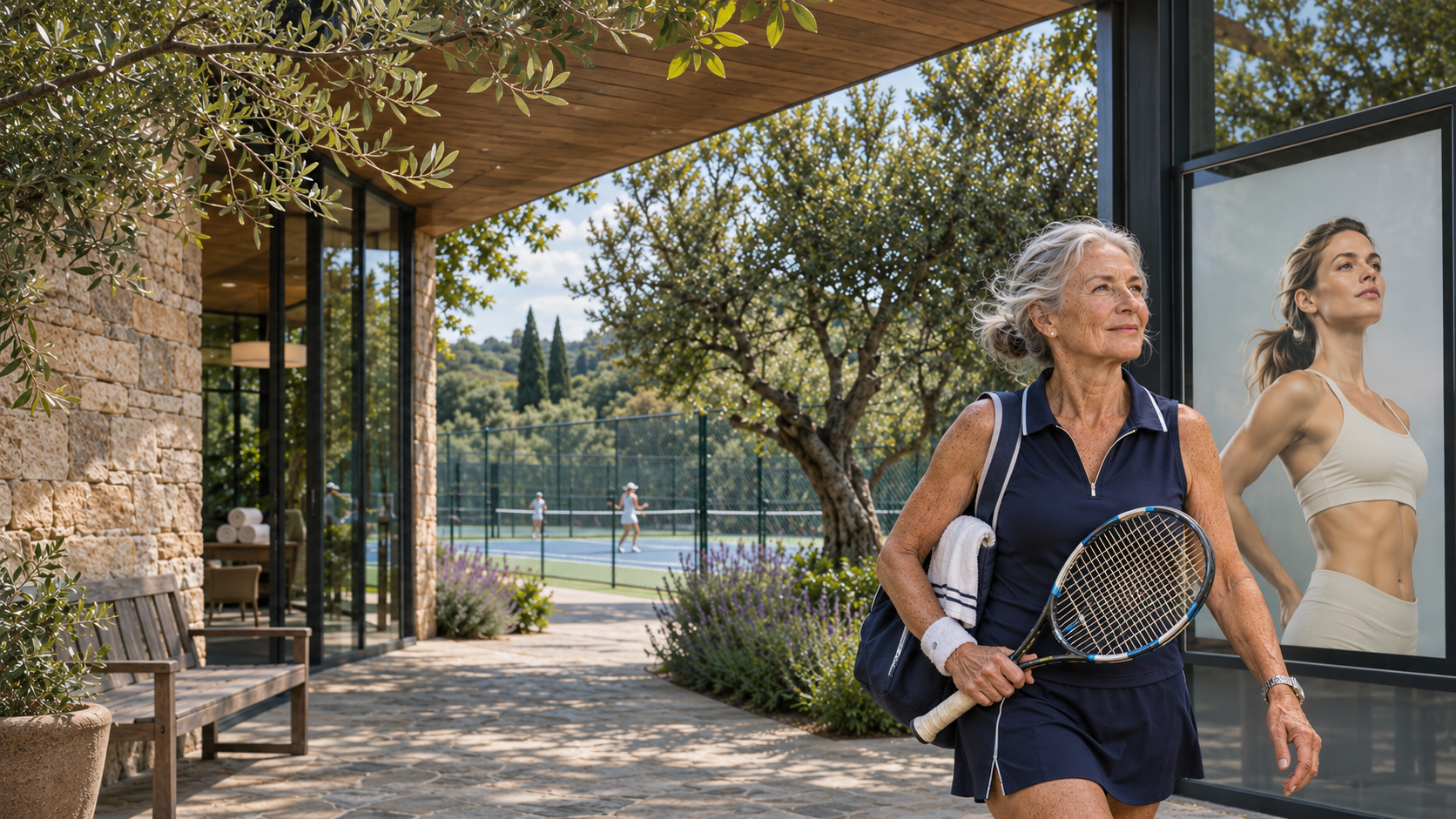


Welcome to the longevity industry. Here, we debate whether people might one day live to 120. In the advertising images, they are usually 35. Perfect skin, athletic bodies, a little silver in their hair and the expression of someone who has probably never had a bad night’s sleep.
We measure biological age, analyse blood markers, discuss mitochondria and develop programmes whose names would look equally at home on a spaceship’s control panel. Imagine a 76-year-old woman interested in one of these offerings. She leads an active life, is perfectly comfortable using her smartphone and wants to know what would actually benefit her.
Booking requires a customer account, the questionnaire has 47 mandatory fields, and getting onto the futuristic treatment couch requires a level of flexibility that you probably need the premium longevity programme to develop in the first place.
But the brochure is spectacular.
«Age is just a number.»
I have spent many years working with recovery, health technologies and the business models behind them. Much of what is happening in research excites me. What excites me less is how often we develop the technology first, package the offering next and only at the very end try to work out who it was actually intended for.
When it comes to ageing, of all things, that could prove expensive. We want people to live as long as possible. Yet in a surprising number of concepts, what they want from those extra years comes after the technical specifications.
Three thoughts from this edition
The economic influence of people over 60 is enormous. That alone does not create a single paying wellness guest.
Ageing healthily does not automatically mean wanting to look younger. Often, it is about capabilities, independence and the things that make life worthwhile.
Anyone who wants to build a business around this needs to understand their customers, create a suitable offering and demonstrate that people actually use it and pay for it.
19 trillion dollars. And we show them 35-year-old models.
According to World Data Lab’s calculations, people aged 60 and over account for around US$19 trillion in consumer spending worldwide in 2026... about a quarter of all spending, although they represent only around 15 per cent of the world’s population. By 2036, that figure is projected to rise to around US$34 trillion.
Before anyone doubles the size of their spa: that US$19 trillion includes food, housing, transport and much else. It is not a wellness market. Whether a hotel in Graubünden or a practice in Zürich sees a single franc of it is not decided by the global statistics.
Even so, the scale shows how little sense it makes to treat older people as a niche group. According to the WHO, around one in six people will be at least 60 by 2030. In August 2026, the Global Wellness Institute explicitly criticised the wellness industry for often overlooking this group or addressing it through inappropriate portrayals of age.
You can already see it in some brochures. The smiling woman in a beige cardigan holds a cup of tea. Particularly innovative marketing departments now give her a matcha instead. The audience analysis remains the same: 65+, retired, health-conscious, affluent.
Yet this category also contains people who run five kilometres every morning, lead companies, need support after surgery or walk to the market with a rollator. A birth year tells us surprisingly little about what they plan to do tomorrow and what they will willingly spend money on.
We know exactly how old our target audience is. We have often failed to ask what they want to do with the years ahead.
At 80, I don’t want to look 35. I want to still play tennis.
I spend a lot of time on the tennis court. Training, footwork, technique, recovery. All voluntarily, sometimes with an enthusiasm I wish I had once felt for certain business tasks. What motivates me is that I can improve. That also includes wanting to keep playing for as long as possible.
Still playing tennis at 80 would be wonderful. Probably more slowly, possibly more intelligently. If my second serve still has its own ideas about accuracy by then, at least I could convincingly blame my age.
That is what I train for today. Not to see a prettier number on a biological age clock.
Other people have other goals. A woman wants to keep doing her favourite hike. A man wants to be able to do his own shopping again after an illness. Someone wants to travel without much help, play with their grandchildren or tend their own garden. None of these ambitions is smaller than another.
The WHO describes healthy ageing partly through “functional ability”: the capabilities and opportunities people need to keep doing and being what matters to them. Physical capacity is not the only factor; the environment and available support count too. This is no guarantee that ageing can be stopped. It is a much more sensible question than whether we can still look 45 at 70.
For one person, it is two hours on the tennis court. For another, twenty metres to the letterbox. Both can be priceless.
Five saunas. One guest. Too many questions.
Take a beautiful wellness hotel. Five saunas, a pool overlooking the mountains and a treatment menu that you would almost need to take time off work to get through. A 73-year-old guest arrives for a hiking trip. He wants to head out again the next morning, is looking for a pleasant, suitable treatment this evening and certainly has a budget for it.
The hotel can explain the differences between various devices, oils and rituals. Or it can offer him a clearly described treatment that is easy to book and fits his evening. The guest knows how long it takes, what it costs, who provides it and what he can realistically expect. The hotel can see whether the service is used, booked again and actually earns something after staff and operating costs are deducted.
No spectacular reinvention of hospitality. For some businesses, simply making it bookable would already be an innovation.
In a clinical practice, the standard is different. There, professional assessment, appropriate treatment and medically responsible claims are required. A healthtech manufacturer, in turn, should be able to explain which applications of its technology offer scientifically supported benefits. HBOT. IHHT. Cryotherapy chambers, PEMF, photobiomodulation and other methods must not be marketed indiscriminately as proven ways to live longer or more independently. The evidence depends on the device, the application and the outcome studied.
This creates work for the consultant too. But different work from the next “Holistic Healthspan Transformation Journey” with 84 slides. On Monday, the spa team wants to know what to tell the guest. After three months, management wants to know what was booked.
Between those two points lie the challenges that make good advice worth its price.
The 100-guest test.
In May 2026, P. K. Kannan and colleagues published an article on the silver economy in the Journal of the Academy of Marketing Science. Their central demand: stop assuming that people of a certain age automatically form a homogeneous target group. Instead, providers should consider factors including needs, accessibility, affordability, emotional relevance and recommendations to others.
What interests me is what this becomes in practice. Take your last 100 guests, customers or patients and examine, where the data is lawfully available, who uses which services, which offerings go unused, where additional revenue comes from and who returns. Do not blindly divide people by birth year. Look at motivations, situations of use and purchasing behaviour.
Then speak with ten people from the group you want to understand better. Not: “What do you think of our premium longevity journey?” Ask what they would still like to be doing in ten years, what they already spend money on today and what is missing from your offerings.
Ten conversations are not a representative market study. But they can provide ten very good reasons to ask the right questions before your next investment. Whether a business model emerges is then demonstrated by actual bookings, willingness to pay and repeat purchases.
The most expensive mistake would be to skip these conversations, order the new treatment couch and only start wondering who is supposed to lie on it when you open the doors.
My question for this week
The Global Wellness Institute names “Functional Longevity” as its first Aging-Well trend for 2026. More strength, mobility, independence and quality of life, rather than an exclusive focus on looking youthful. As an industry trend, that makes sense to me; whether a specific offering works still has to be proven.
Research into ageing will teach us much more. I hope for better diagnostics, useful technologies and offerings that actually help people. Even so, I would start the next concept with a very simple question:
WHAT DO YOU STILL WANT TO BE ABLE TO DO AT 80?
The answer could be tennis, travelling, working, gardening or eating breakfast independently.
Anyone who knows the answer has at least a chance of developing an offering that people need. Anyone who does not can turn their attention to the next trend presentation.
It is sure to be ultra fancy.


