
News summary

Senescent-like activated naive B cells contribute to progression to clinical rheumatoid arthritis

Source: Nature Aging • Published: 14 Oct 2026, 00:00

Summarized by Masters of Longevity from Nature Aging.

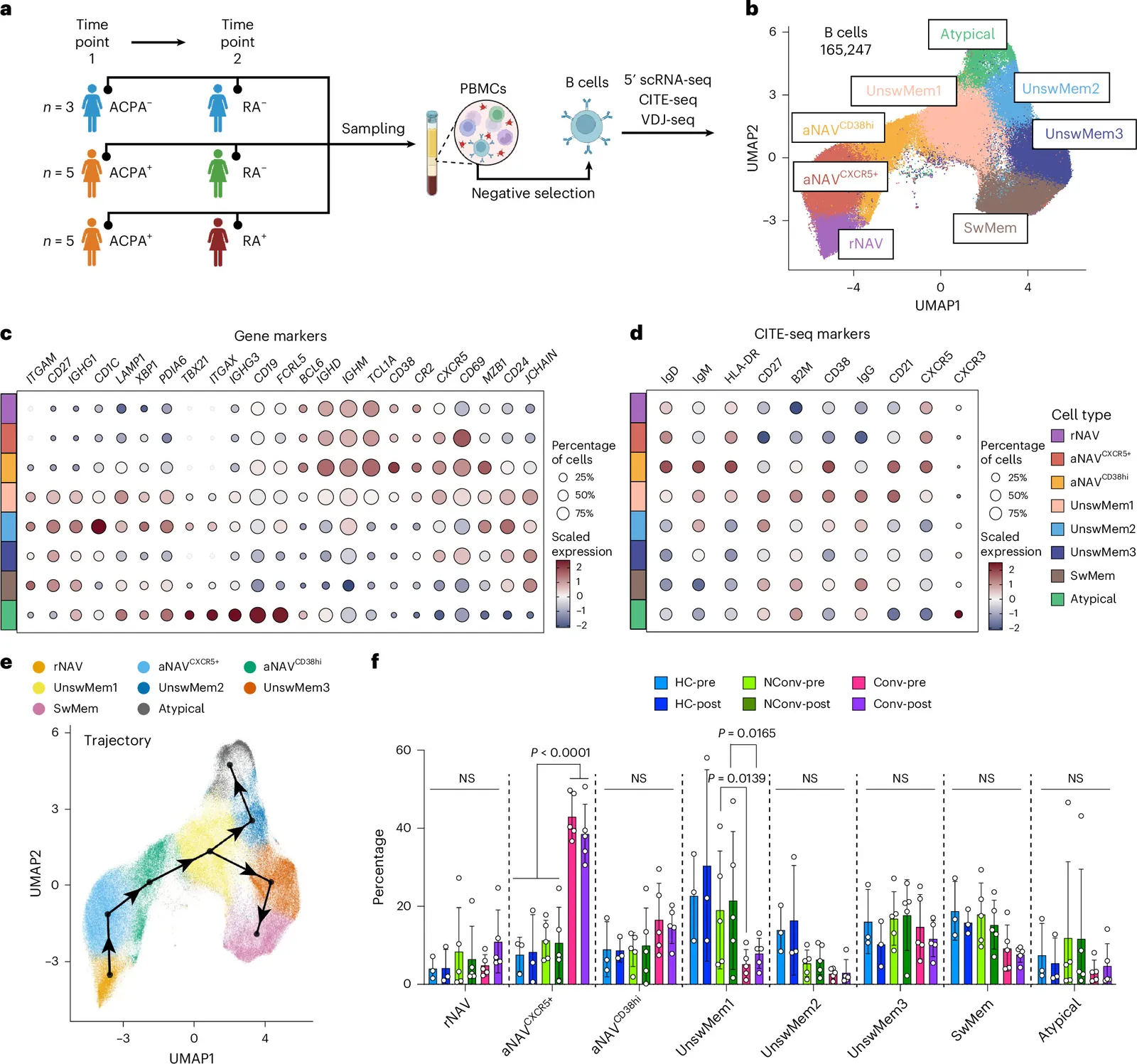
Activated, senescent-like naive B cells are the focus of a research article examining immune changes that precede clinical rheumatoid arthritis; it previews molecular and functional analyses exploring their potential role in disease progression.
Senescent-like activated naive B cells contribute to progression to clinical rheumatoid arthritis
Key Takeaways
  • Anticitrullinated-protein-antibody-positive individuals who progressed to RA showed marked expansion of CXCR5+ CD69+ activated naive B cells.
  • These activated naive B cells exhibited inflammatory and senescent-like transcriptional programs and dominated the BCR repertoire with unmutated polyreactive IgM.
  • Citrullinated-antigen stimulation drove these B cells to present antigen and activate T cells in an HLA-dependent manner in vitro.
Read the full article at Nature Aging ↗

Continue exploring

Recommended MoL Picks

MoL PickWhat Changes in the Human Hippocampus with Age?A study of 40 postmortem brains maps a midlife shift in immune cells and a wider loss of cellular and genome organisation—but it does not show how to prevent cognitive decline.MoL PickCan You Really Measure Whether You’re Aging More Slowly?A younger epigenetic-age score can look like proof that an intervention is working. A major new analysis shows which clocks detect change—and why movement is not yet the same as longer healthspan.MoL PickReducing Inflammation from Ageing Cells: What a Mouse Study FoundResearchers reduced the inflammatory signals released by cells that had stopped dividing. Older mice also improved on some strength and frailty tests. Whether this approach could help people remains unknown.