
News summary

Adipose Tissue Dysfunction and the Liver: Reframing MASH as the Hepatic Expression of Systemic Metabolic Dysfunction

Source: Frontiers - Health • Published: 25 Sept 2026, 00:00

Summarized by Masters of Longevity from Frontiers - Health.

This mini-review invites readers into a conceptual reframing that treats liver inflammation as the downstream sign of systemic adipose failure, offering an upstream, adipose-focused lens for researchers and clinicians.
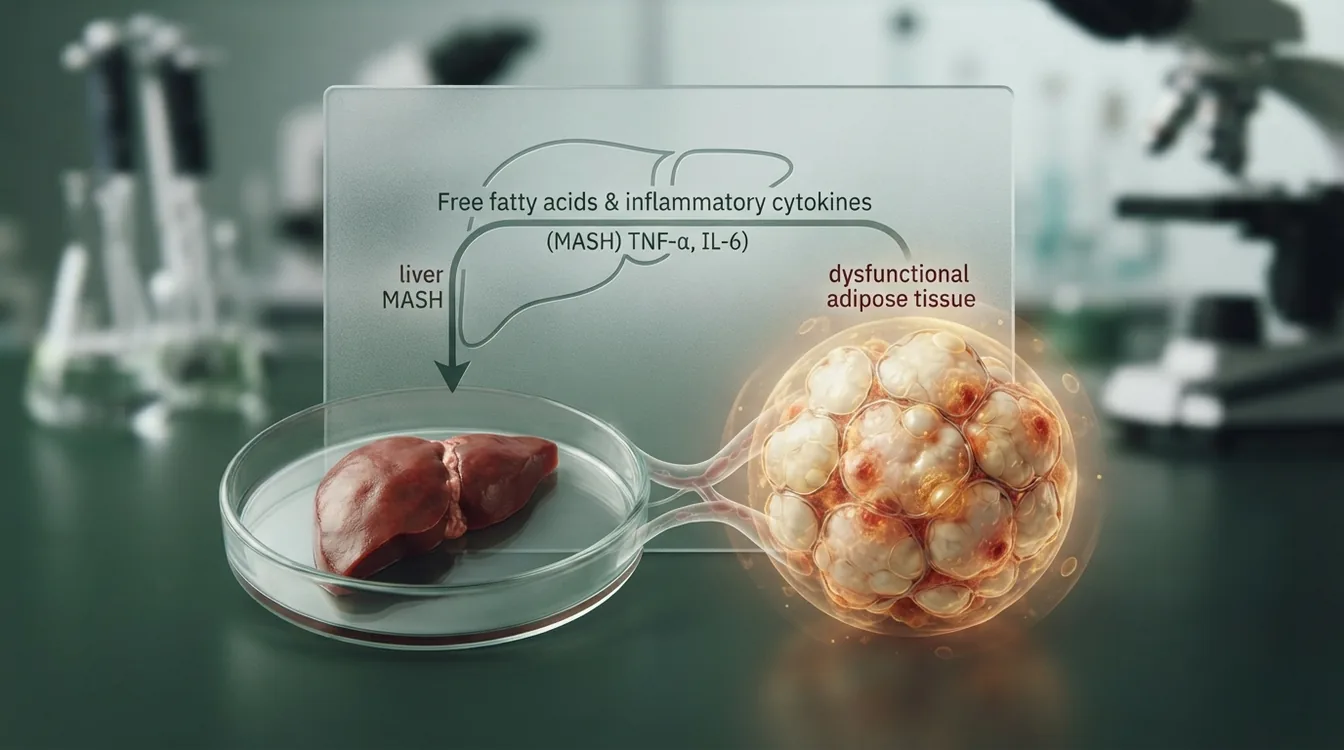
Adipose Tissue Dysfunction and the Liver: Reframing MASH as the Hepatic Expression of Systemic Metabolic Dysfunction
Key Takeaways
  • Adipose inflammation and a reconfigured adipokine secretome produce selective insulin resistance and systemic metabolic inflexibility.
  • Hepatic steatosis and steatohepatitis arise from failed peripheral lipid buffering and increased lipotoxic, immunometabolic burden on the liver.
Read the full article at Frontiers - Health ↗

Continue exploring

Recommended MoL Picks

MoL PickReducing Inflammation from Ageing Cells: What a Mouse Study FoundResearchers reduced the inflammatory signals released by cells that had stopped dividing. Older mice also improved on some strength and frailty tests. Whether this approach could help people remains unknown.MoL PickThe Next Obesity-Drug Race Is About What Weight You LoseRegeneron’s myostatin and activin A antibodies point to a sharper question for the GLP-1 era: not whether people can lose more weight, but whether medicine can preserve the tissue that makes weight loss healthier.MoL PickApoB: The cholesterol signal LDL can missIn longevity medicine, the useful biomarkers are not always the exotic ones. ApoB is a relatively simple blood test that can sharpen cardiovascular prevention when LDL-C looks reassuring but particle burden remains high.